

If you're sourcing air compressed oil filters and a customer asks whether they fit a screw air compressor, the answer seems simple — until a return request lands on your desk. The real problem isn't whether the filter physically fits. It's whether the filter functionally matches the compressor's requirements across every specification that matters.
An air compressed oil filter can be used for a screw air compressor, but only when the filter's exact function, installation position, and full technical specifications — not just physical dimensions — match the compressor manufacturer's requirements. A filter that threads into place but fails to meet flow, pressure, or filtration-rating specs can cause procurement disputes, equipment issues, and unsaleable inventory.
That bold-text answer carries more nuance than it appears. Below, I'll walk you through the exact verification process we use at our factory when distributors and importers send us a part number and ask, "Can this work?" By the end, you'll have a repeatable method for confirming filter compatibility before committing to a purchase order.
What Does "Oil Filter" Actually Mean in a Screw Air Compressor System?
Before you can answer the compatibility question, you need to define which component you're actually discussing. The term "oil filter" is used loosely across the compressed-air industry, and I've seen it cause confusion in procurement conversations dozens of times.
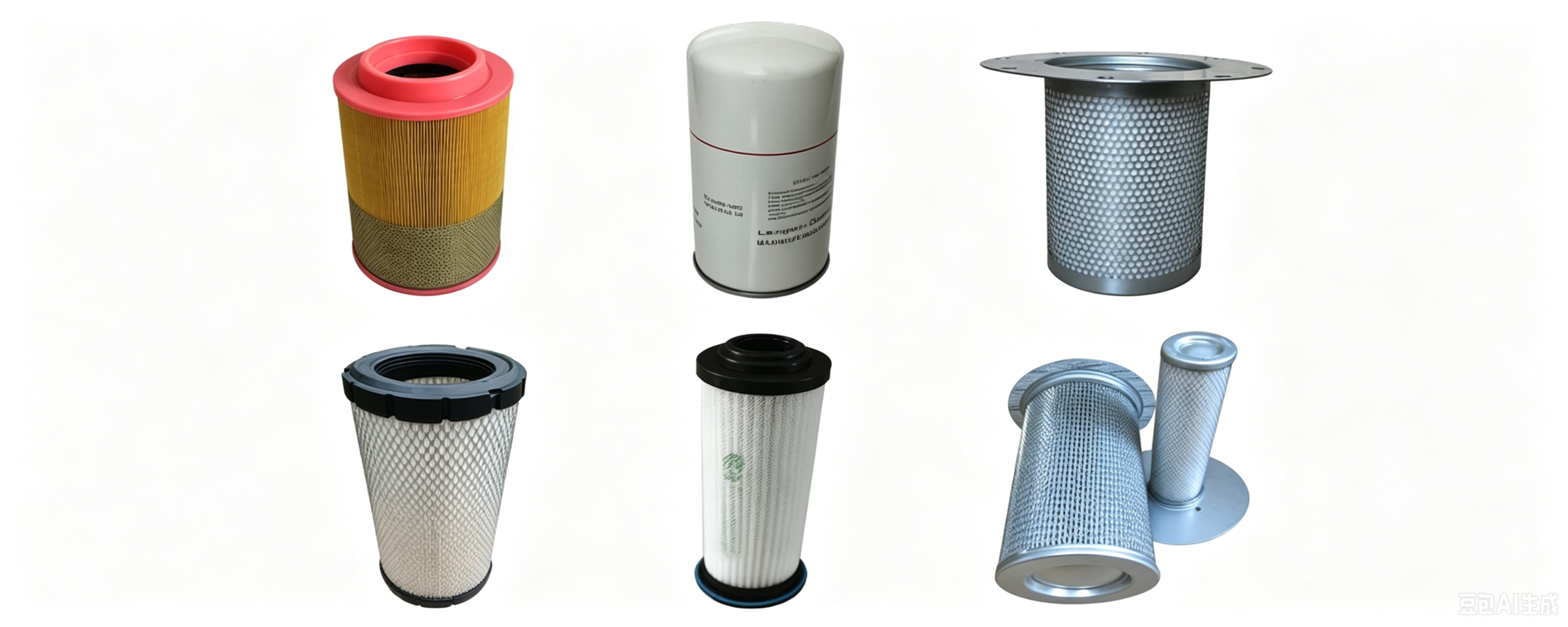
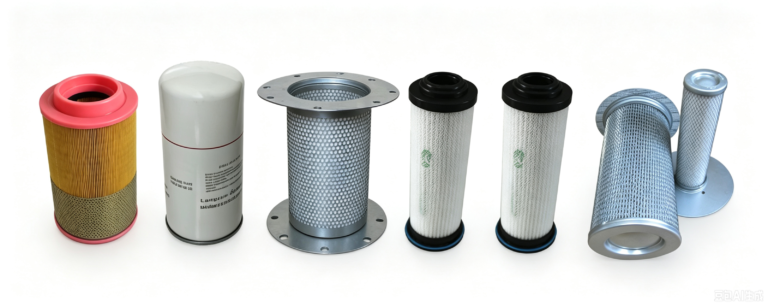
In a screw air compressor system, the phrase "oil filter" can refer to at least three distinct components, each serving a different function and installed in a different position. Mixing them up during sourcing leads to wrong orders, delayed shipments, and strained supplier relationships.
The Three Components Buyers Commonly Call "Oil Filter"
Here's where the confusion starts. When a buyer says "I need an oil filter for my screw compressor," they might mean any of the following:
| Component | Common Name(s) | Function | Installation Position |
|---|---|---|---|
| Oil filter element | Oil filter, lube oil filter, oil cleaner | Removes particulate contamination from circulating lubricant oil1 | Installed in the oil circuit, typically between the oil reservoir/separator tank and the compressor airend |
| Oil separator element | Oil separator, oil-air separator, oil separator cartridge | Separates residual oil mist from compressed air before it exits the system2 | Installed inside or on top of the oil separator tank/vessel |
| Inline oil removal filter | Compressed air oil filter, coalescing filter, oil removal filter | Removes oil aerosols and vapors from the compressed air downstream of the compressor | Installed in the compressed air piping after the compressor unit |
Each of these has a completely different:
- Filtration mechanism (barrier filtration vs. coalescence vs. adsorption3)
- Operating pressure range
- Flow direction and internal construction
- Media type and grade
- Connection interface
Why This Distinction Matters for Procurement
If a distributor orders an inline coalescing filter thinking it's an oil filter element for the airend lubrication circuit, the part is useless for that application — even if the thread size happens to match. I've processed inquiries where buyers sent us a part number for an oil separator element but described it as an "oil filter." Without clarifying the function first, any cross-reference attempt is unreliable.
Rule of thumb: Never approve a replacement filter based on the common name alone. Always confirm the original part number, the compressor model, and where the filter sits in the system.
Does "It Fits" Really Mean "It Works" for Screw Compressor Oil Filters?
This is the single most dangerous assumption in filter procurement. A filter that physically installs — same thread, same housing diameter, same length — can still be functionally wrong. And the consequences for a distributor or wholesaler go beyond a single return.
A physically compatible filter that doesn't meet the compressor's flow rate, filtration rating, pressure differential limits, or bypass valve specifications may allow contaminated oil into the airend, restrict oil flow under load, or fail to maintain proper separation efficiency. The commercial consequences include warranty disputes, customer churn, and inventory write-offs.
Specifications That Must Match Beyond Dimensions
When we cross-reference a filter at our facility, physical dimensions are the starting point — never the finish line. Here are the parameters we check:
| Specification Category | What We Verify | Why It Matters |
|---|---|---|
| Thread / interface | Thread type (e.g., M30×1.5, 1"-12 UNF), gasket seat, O-ring groove | Incorrect thread pitch or seal type causes leaks or improper seating |
| Outer diameter & height | Housing OD, total element length, collapsed height | Must fit inside the filter housing or canister without interference |
| Filtration rating | Micron rating (absolute vs. nominal4), media type (cellulose, synthetic, glass fiber5) | Too coarse = contamination passes through; too fine = premature clogging |
| Flow capacity | Rated oil flow (L/min or GPM) at operating viscosity | Undersized flow causes starvation; oversized may reduce filtration efficiency |
| Pressure differential (ΔP) | Clean ΔP and maximum allowable ΔP before bypass opens | Mismatched ΔP affects oil circulation and triggers false maintenance alarms |
| Bypass valve setting6 | Cracking pressure of the built-in bypass valve (if present) | Wrong bypass pressure can allow unfiltered oil to circulate or prevent bypass entirely |
| Collapse/burst pressure | Maximum reverse-pressure the element can withstand | Insufficient rating risks element failure under cold-start or high-viscosity conditions |
| Internal construction | Center tube perforation pattern, end cap bonding, anti-drain-back valve | Affects flow distribution, structural integrity, and oil retention at shutdown |
A Real Cross-Referencing Scenario
Let me illustrate. A distributor in Southeast Asia recently sent us two part numbers: one from a well-known European compressor OEM, one from a generic aftermarket catalog. Both had identical outer dimensions (93mm OD × 170mm height) and the same thread (3/4"-16 UNF). On paper, they looked interchangeable.
When we pulled the specifications, here's what we found:
- Filtration rating: The OEM filter used synthetic media rated at 10 microns (absolute). The generic used cellulose media rated at 25 microns (nominal).
- Bypass valve: The OEM filter had a bypass valve set at 2.5 bar. The generic had no bypass valve at all.
- Collapse pressure: The OEM element was rated for 20 bar collapse. The generic was rated for 10 bar.
Same dimensions. Same thread. Completely different functional performance. If the distributor had purchased the generic as a direct replacement, their end-users would have experienced accelerated airend wear from insufficient filtration7 and potential element collapse during cold starts8.
Key takeaway for buyers: Always request the full technical data sheet — not just a dimensional drawing — when evaluating a replacement filter.
How Should Buyers Verify Oil Filter Compatibility for Screw Compressors?
Without a structured verification process, every replacement filter purchase carries hidden risk. Most procurement disputes I've seen trace back to incomplete information at the inquiry stage, not to manufacturing defects.
The most reliable way to verify oil filter compatibility is to follow a step-by-step specification-matching process: start with the compressor model and original part number, then confirm every functional specification against the replacement candidate before placing an order.
The 6-Step Verification Process We Recommend
Over years of processing cross-reference requests from distributors across Russia, the Middle East, Southeast Asia, and South America, we've developed a practical checklist. Here's the process we recommend to every buyer:
Step 1: Identify the compressor make, model, and serial number range. Different serial number ranges of the same model may use different filter specifications due to engineering revisions9. Don't skip this.
Step 2: Obtain the original filter part number. This is your anchor. Every credible cross-reference starts from a verified OEM or OES part number. If the buyer can't provide one, ask for photos of the existing filter's label.
Step 3: Collect physical specifications. Measure or confirm:
- Overall height (with and without gasket)
- Outer diameter
- Inner diameter (if applicable for elements)
- Thread type and pitch
- Gasket or O-ring dimensions
Step 4: Confirm functional specifications. Request or research:
- Filtration media type and micron rating
- Rated flow capacity
- Operating pressure range
- Bypass valve presence and cracking pressure
- Collapse/burst pressure rating
Step 5: Verify internal construction. If possible, obtain a cross-section photo or cutaway drawing. Check:
- Center tube material and perforation
- End cap material and bonding method
- Number of pleats and pleat depth
- Presence of anti-drain-back valve
Step 6: Cross-reference against the replacement candidate. Compare every parameter from Steps 3–5 against the proposed replacement. Document any deviations and assess whether they fall within acceptable tolerances.
What Documents Should Buyers Request From a Supplier?
When you're evaluating a potential replacement filter from any supplier, here's what to ask for:
- Technical data sheet with all specifications listed above
- Dimensional drawing with tolerances
- Cross-reference table showing which OEM part numbers the replacement covers
- Material certifications (filter media, gasket material, adhesive)
- Photos of the actual product, including end caps, center tube, and media
Practical note: If a supplier can only provide dimensions and a cross-reference number but cannot supply filtration rating, bypass valve data, or media specifications, that's a significant gap. Proceed with caution.
Why Do Mismatched Oil Filters Create Commercial Problems for Distributors?
Technical incompatibility is an engineering issue. But for distributors, importers, and wholesalers, the fallout is commercial. Understanding this helps frame filter compatibility not as a technical curiosity but as a business-critical procurement decision.
A mismatched oil filter doesn't just risk equipment damage — it creates return requests, warranty claims, lost repeat orders, and reputational harm that costs far more than the price difference between a properly matched filter and a cheap substitute.
The Chain Reaction of a Wrong Filter
Here's how a single mismatched filter purchase typically escalates for a distributor:
- Buyer orders filters based on dimensional match alone. Everything looks correct in the catalog.
- End-user installs the filter. It threads on, seals properly, and the compressor runs.
- Performance deviates over weeks or months. Higher oil carryover, increased operating temperature, premature maintenance alerts, or degraded air quality downstream10.
- End-user contacts the distributor. They blame the filter. They want a refund, a replacement, or they simply switch suppliers.
- Distributor contacts the filter manufacturer. A dispute begins over whether the product was "as specified."
- Remaining inventory becomes a liability. If the mismatch is confirmed, unsold stock of that filter for that application is unmarketable.
Cost Comparison: Proper Verification vs. After-the-Fact Returns
| Scenario | Estimated Cost | Time Impact |
|---|---|---|
| 30 minutes of specification verification before ordering | Minimal (staff time only) | 1–2 days added to inquiry stage |
| Processing a return shipment for 500 mismatched filters | Shipping cost + restocking + credit note + lost margin | 2–6 weeks |
| Losing a repeat customer due to quality complaint | Lifetime value of the account | Permanent |
The math is straightforward. Spending time on verification before the purchase order is issued costs almost nothing relative to the commercial damage of a mismatch discovered after installation.
How We Handle This at Our Factory
When a distributor sends us a cross-reference inquiry, we don't simply look up the dimensions and confirm "yes, we have it." Our engineering team checks the full specification set against our production records. If there's a parameter we can't verify — for example, if the OEM doesn't publish its bypass valve setting — we flag it and recommend the buyer verify that spec independently.
We also maintain a library of OEM filter cross-sections and dimensional profiles for major compressor brands. This allows us to match not just catalog specs but actual internal construction details. It's one of the advantages of manufacturing filters rather than simply trading them.
When Should Buyers Consider Custom-Matched Filters Instead of Catalog Cross-References?
Standard cross-reference tables cover the most common compressor models and filter part numbers. But the screw-compressor market includes hundreds of regional brands, OEM-specific variants, and legacy models where a catalog match doesn't exist.
When no existing catalog cross-reference matches all specifications of the required oil filter, a custom-matched or custom-manufactured filter — built to the exact dimensional and functional requirements — is often the most reliable and commercially defensible solution for distributors.
Situations That Call for Custom Matching
- Regional or lesser-known compressor brands not covered by major cross-reference databases
- Discontinued OEM part numbers where the original specification is no longer published
- Modified or upgraded compressors where the original filter housing has been altered
- Private-label or OEM-branded requirements where the distributor needs specific packaging, printing, or labeling
What Information Does a Manufacturer Need for Custom Matching?
If you're requesting a custom-matched filter, here's what to prepare:
- Original filter sample (used or new) — this is the single most valuable piece of information
- Compressor model and nameplate photo
- Dimensional measurements with calipers (not estimates)
- Operating conditions: ambient temperature range, oil type and viscosity, operating pressure, duty cycle
- Photos of the filter housing and connection interface
- Desired order quantity and any OEM/branding requirements
With this information, a capable manufacturer can produce a prototype, verify the match, and proceed to production. At our facility, this process typically takes 5–10 working days for the prototype stage11, depending on complexity.
Custom Matching vs. Universal Filters
Some suppliers market "universal" oil filters that claim to fit multiple compressor brands. While universal filters may physically install in various housings, they inherently compromise on at least one specification to achieve broad compatibility12. For distributors whose reputation depends on delivering reliable replacement parts, a precisely matched filter is a safer commercial bet than a universal compromise.
Frequently Asked Questions
Can I use any oil filter as long as the thread size matches my screw compressor?
No. Thread size is only one of many critical specifications. Filtration rating, flow capacity, bypass valve setting, collapse pressure, and media type must also match. A filter that threads on correctly but fails to meet these functional specs can lead to equipment problems and procurement disputes.
What's the difference between an oil filter and an oil separator in a screw compressor?
An oil filter removes particulate contamination from the lubricating oil circulating within the compressor. An oil separator removes residual oil mist from the compressed air before it exits the system. They serve different functions, install in different positions, and are not interchangeable.
How do I find the correct replacement oil filter part number for my compressor?
Start with the compressor manufacturer's model and serial number. Check the OEM service manual or parts list for the recommended filter part number. If you're sourcing an aftermarket replacement, provide this OEM part number to your supplier and request a full specification cross-reference — not just a dimensional match.
Is it safe to use aftermarket oil filters in brand-name screw compressors?
Aftermarket oil filters can perform equivalently to OEM filters when they match all relevant specifications. The key is verifying the match through a complete specification comparison. Buyers should request technical data sheets and confirm filtration rating, pressure ratings, and internal construction before approving a replacement.
Can one oil filter model work across multiple screw compressor brands?
While some filter specifications overlap between brands, no single filter model is universally compatible across all screw compressors. Each compressor model has specific requirements. Always verify compatibility on a model-by-model basis rather than assuming cross-brand interchangeability.
Conclusion
The question of whether an air compressed oil filter can be used for a screw air compressor doesn't have a simple yes-or-no answer. It depends entirely on correctly identifying the filter's function, confirming its installation position, and verifying that every specification — from mic
"Working principle of a screw compressor", https://www.atlascopco.com/en-us/compressors/wiki/compressed-air-articles/rotary-screw-compressor. Standard references on oil-injected rotary screw compressor design describe the oil circuit as flowing from the separator vessel through an oil cooler and oil filter before returning to the compression chamber, with the filter positioned to protect the airend from particulate contamination. Evidence role: mechanism; source type: education. Supports: The oil filter in an oil-injected rotary screw compressor is positioned in the oil circulation circuit to remove particulates before oil re-enters the airend.. Scope note: Exact filter placement may vary by manufacturer and model; the general circuit topology is well-established but specific routing differs. ↩
"Flow Visualization and Analytical Model of Coalescing Oil ...", https://docs.lib.purdue.edu/cgi/viewcontent.cgi?article=3597&context=icec. Engineering literature on rotary screw compressors describes the oil separator element as a coalescing filter that captures fine oil aerosols entrained in the compressed air, typically reducing residual oil content to 2–5 ppm before the air exits the compressor package. Evidence role: mechanism; source type: education. Supports: Oil separator elements in rotary screw compressors use coalescence to capture oil aerosols from the compressed air stream, reducing oil carryover to downstream systems.. Scope note: Residual oil carryover figures vary by separator design, operating conditions, and compressor manufacturer specifications. ↩
"Tag: coalescing filter", https://blog.exair.com/tag/coalescing-filter/. Compressed air treatment literature distinguishes barrier (or depth) filtration for particulate removal, coalescence for liquid aerosol agglomeration and drainage, and adsorption (typically activated carbon) for vapor-phase oil removal, each applied at different points in the air treatment chain. Evidence role: definition; source type: research. Supports: Barrier filtration, coalescence, and adsorption are distinct separation mechanisms used in different stages of compressed air treatment.. Scope note: The classification is well-established in filtration science but specific implementation details vary across compressor and filter manufacturers. ↩
"Nominal vs. Absolute Micron Filter Rating | Beta Ratio", https://qualityhydraulics.com/blog/filtration/absolute-vs-nominal-filter-ratings. Industry standards such as ISO 16889 define filter efficiency through multi-pass testing (beta ratio), which provides an 'absolute' rating at a specified efficiency level, whereas 'nominal' ratings lack a standardized test protocol and typically indicate a lower, less reliable capture efficiency at the stated particle size. Evidence role: definition; source type: institution. Supports: Absolute and nominal micron ratings represent fundamentally different measures of filter efficiency, with absolute ratings defined by standardized multi-pass testing and nominal ratings being less precisely defined.. Scope note: The term 'absolute' is itself used inconsistently across manufacturers; ISO 16889 beta ratios provide the most rigorous comparison framework. ↩
"Glass or Cellulose: Which Hydraulic Filter Media is Best?", https://www.hyprofiltration.com/blog/bid/222084/glass-or-cellulose-which-hydraulic-filter-media-is-best. Filtration research demonstrates that glass fiber and synthetic media generally achieve higher filtration efficiency at finer micron ratings and greater dirt-holding capacity compared to cellulose media, though cellulose remains widely used for cost-effective applications with less demanding filtration requirements. Evidence role: mechanism; source type: research. Supports: Cellulose, synthetic, and glass fiber filter media offer different filtration efficiencies, dirt-holding capacities, and service life characteristics in oil filtration applications.. Scope note: Performance comparisons depend on specific media construction, pleat geometry, and operating conditions; media type alone does not fully determine filter performance. ↩
"Exactly how does a bypass valve work?", https://bobistheoilguy.com/forums/threads/exactly-how-does-a-bypass-valve-work.23682/. Filtration engineering texts explain that the bypass valve in a spin-on oil filter is a pressure-relief device calibrated to open at a specific differential pressure, ensuring oil flow to critical components when the filter element reaches its maximum allowable pressure drop; an incorrect cracking pressure can either allow unfiltered oil to bypass prematurely or prevent bypass under high-viscosity conditions, risking oil starvation. Evidence role: mechanism; source type: education. Supports: The bypass valve in an oil filter opens at a predetermined differential pressure to ensure continued oil flow when the filter element is clogged or oil viscosity is high, and its cracking pressure must match the system design.. Scope note: Not all oil filter designs incorporate a bypass valve; some compressor systems use an external bypass circuit, making this specification relevant only to filters with integrated bypass valves. ↩
"The importance of screw compressor maintenance schedule", https://compressors.cp.com/en-international/expert-corner/blog/air-compressor-maintenance-tips/screw-compressor-maintenance-schedule. Research on tribological wear in lubricated rotating machinery demonstrates that particulate contamination in lubricating oil significantly accelerates bearing and rotor surface degradation, with filtration fineness directly correlated to component service life. Evidence role: mechanism; source type: paper. Supports: Inadequate oil filtration allows abrasive particulates to circulate through the airend, accelerating wear on bearings and rotors in rotary screw compressors.. Scope note: Most published studies address general rotating machinery or hydraulic systems; direct studies on screw compressor airend wear as a function of oil filter micron rating are limited. ↩
"Donaldson "Burst Collapse" Rating", https://bobistheoilguy.com/forums/threads/donaldson-burst-collapse-rating.389061/. Filtration engineering references note that cold-start conditions produce significantly higher oil viscosity, increasing the pressure differential across the filter element; if this differential exceeds the element's collapse pressure rating, structural failure of the center tube or media pack can occur. Evidence role: mechanism; source type: research. Supports: During cold starts, high oil viscosity creates elevated pressure differentials across the filter element, which can exceed the collapse rating of an under-specified element.. Scope note: The magnitude of cold-start pressure spikes depends on ambient temperature, oil grade, and compressor design, so the risk level is application-specific. ↩
"Revision or New Part Number? The F3 Rule Helps ...", https://www.mcl.bz/blog/revision-or-new-part-number-f3-rule-helps-manufacturers-decide. Industrial equipment maintenance references and OEM service documentation practices confirm that manufacturers issue engineering change orders that can alter filter specifications, gasket materials, or internal construction across serial number breaks within a single compressor model line. Evidence role: general_support; source type: other. Supports: Industrial equipment OEMs routinely issue engineering change notices that alter component specifications, including filters, across production serial number ranges of the same model.. Scope note: This is a well-known practice in industrial equipment manufacturing but specific examples are proprietary to individual OEMs and not always publicly documented. ↩
"Preventing Air Compressor Oil Carryover", https://kaishanusa.com/blog/preventing-air-compressor-oil-carryover/. Compressor maintenance literature and troubleshooting guides identify incorrect or degraded oil filtration as a root cause of elevated discharge temperatures (due to restricted oil flow), increased oil carryover past the separator (due to contaminated oil degrading separator performance), and premature differential pressure alarms. Evidence role: general_support; source type: research. Supports: Improperly specified oil filters in screw compressors can lead to measurable performance degradation including elevated discharge temperatures, increased oil carryover, and premature differential pressure alarms.. Scope note: These symptoms can also result from other maintenance issues; attribution to filter mismatch specifically requires case-by-case diagnosis. ↩
"OEM Filter Design & Build Capabilities", https://permatron.com/oem/design-build-capabilities. Industrial filter manufacturing sources indicate that prototype development for custom filter elements typically ranges from one to several weeks depending on design complexity, tooling requirements, and material availability, with simpler spin-on filter adaptations at the shorter end of this range. Evidence role: general_support; source type: other. Supports: Custom filter element prototyping timelines in the industrial filtration manufacturing sector.. Scope note: Prototype lead times are highly manufacturer-specific and depend on existing tooling, material stock, and production scheduling; the 5–10 day figure reflects one manufacturer's capability rather than an industry standard. ↩
"Optimal trade-off synthetic discriminant function filters for ...", https://pubmed.ncbi.nlm.nih.gov/19855582/. Filtration industry analysis notes that universal or multi-application filter designs must accommodate the broadest range of operating conditions, which typically results in compromises such as moderate rather than application-optimized filtration ratings, generalized bypass valve settings, and media selections that balance cost against acceptable performance across diverse systems. Evidence role: expert_consensus; source type: research. Supports: Filters designed for universal compatibility across multiple applications necessarily adopt generalized specifications that may not optimally match any single application's requirements.. Scope note: The degree of compromise depends on how similar the target applications are; universal filters covering closely related compressor models may have minimal performance trade-offs. ↩
Leave a Reply